Plant guide
Haworthia
Haworthiopsis attenuata
Haworthia (Haworthiopsis attenuata) is considered non-toxic to cats. This assessment uses the published Haworthia group listing and the documented older name Haworthia attenuata. Check the botanical label before buying: other plants sold as zebra plants may be different species.
Non-toxic does not mean edible. Eating plant material can still upset your cat’s stomach.
What this guide covers: This guide covers Haworthiopsis attenuata, formerly named Haworthia attenuata. The safety evidence is a genus-level assessment applied to this documented member, not a cat-specific experiment on this species. It does not identify Haworthiopsis fasciata, unrelated zebra plants or unidentified hybrids.
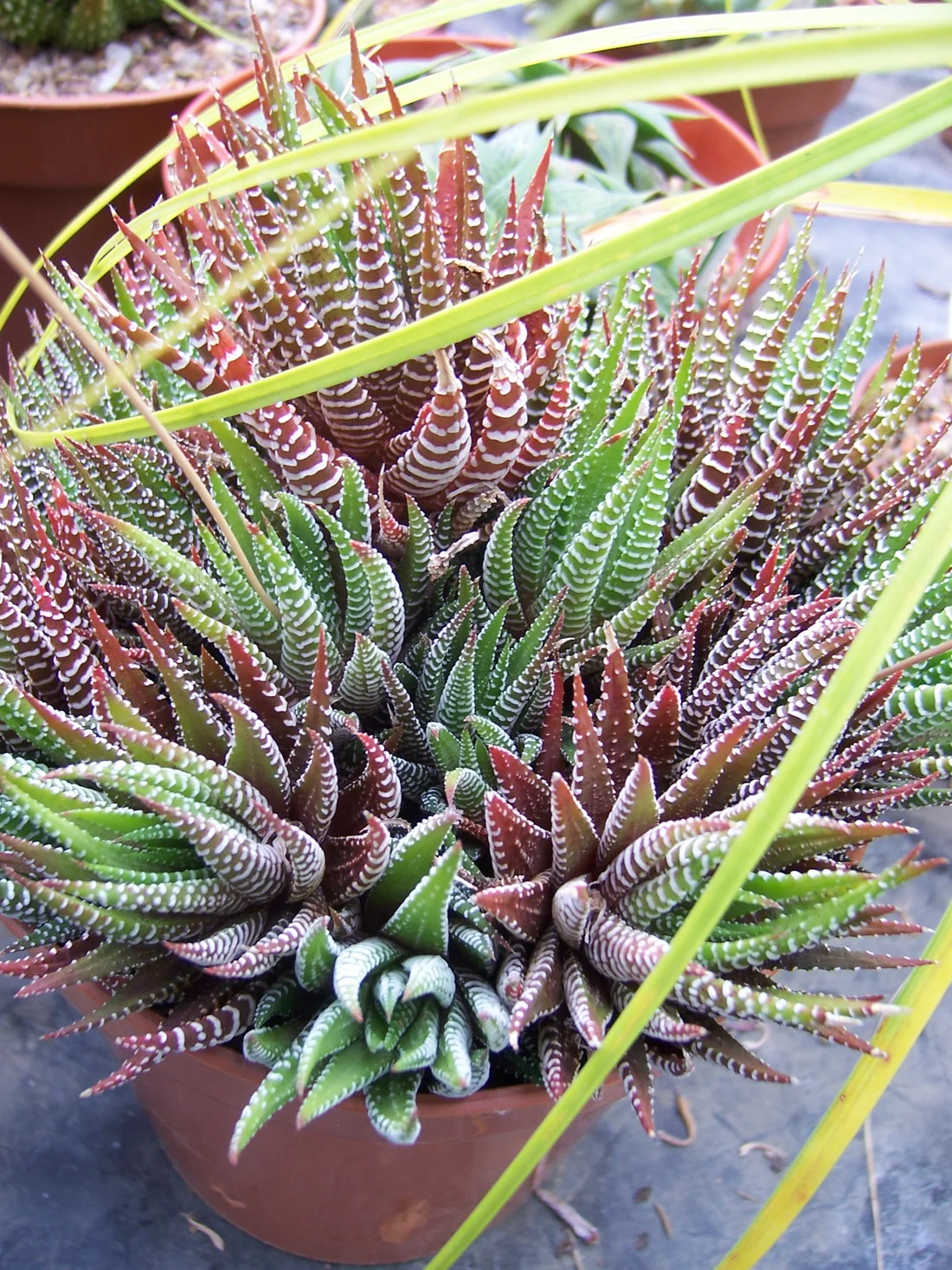
Photo:
Photo details
Winterbourne - Haworthia attenuata (6120983526).jpg
By stephen boisvert from Chicago, United States

License: CC BY 2.0
No botanical or background edits. Standard responsive framing and image format optimization only after acceptance.
Plant identity
- Scientific name
- Haworthiopsis attenuata
- Scope
- Species
- Family
- Asphodelaceae
- Also known as
- No reviewed aliases available
Find the right spot
How to grow this plant
Container growing guidance for Haworthiopsis attenuata.
- Light
- Bright indirect light
Choose bright, indirect light; some lower light is tolerated.
Tolerates lower light; growth or flowering may be reduced. - Watering
- Let the mix dry
Let the mix dry between waterings, then drain thoroughly.
- Temperature
- Growing range: 60–80°F / 16–27°C
Protect from cold; avoid temperatures below 50°F (10°C).
- Humidity
- Typical indoor humidity
Typical indoor humidity is suitable.
- Potting
- Use a freely draining cactus or succulent mix.
- Through the year
- Offsets can be separated when established.
Growing-guide sources
- haworthiopsis attenuata - Extension Gardener Plant Toolbox ↗NC State Extension · Accessed 2026-10-13
Care guidance for the named taxon; indoor recommendations take precedence over outdoor hardiness information.
Growing advice reviewed 2026-10-14. Plant safety is assessed separately.
Reviewed safety information
- Toxic principle
- Not recorded in the reviewed evidence
- Reported signs
- Not recorded in the reviewed evidence
Missing information is unknown. It should not be interpreted as an absence of risk.
Safe alternatives
No verified alternative recommendations are available for this guide.
Sources & review
- Haworthia — published group assessment ↗ASPCA Poison Control · Accessed
Listed by the source as Haworthia species. ASPCA explicitly assesses Haworthia species as non-toxic to cats. Kew treats Haworthia attenuata as a synonym of Haworthiopsis attenuata. The former is a documented historical member of the assessed source genus. This narrows the published group assessment to the master species; it does not claim a species-specific experiment, genus/species equivalence, coverage of unidentified hybrids, or synonymy with fasciata.
- Haworthia attenuata — synonym of Haworthiopsis attenuata ↗Royal Botanic Gardens, Kew · Accessed 2026-10-14
- Haworthia — explicit cat assessment of source genus ↗ASPCA Poison Control · Accessed 2026-10-14
Safety last reviewed .